

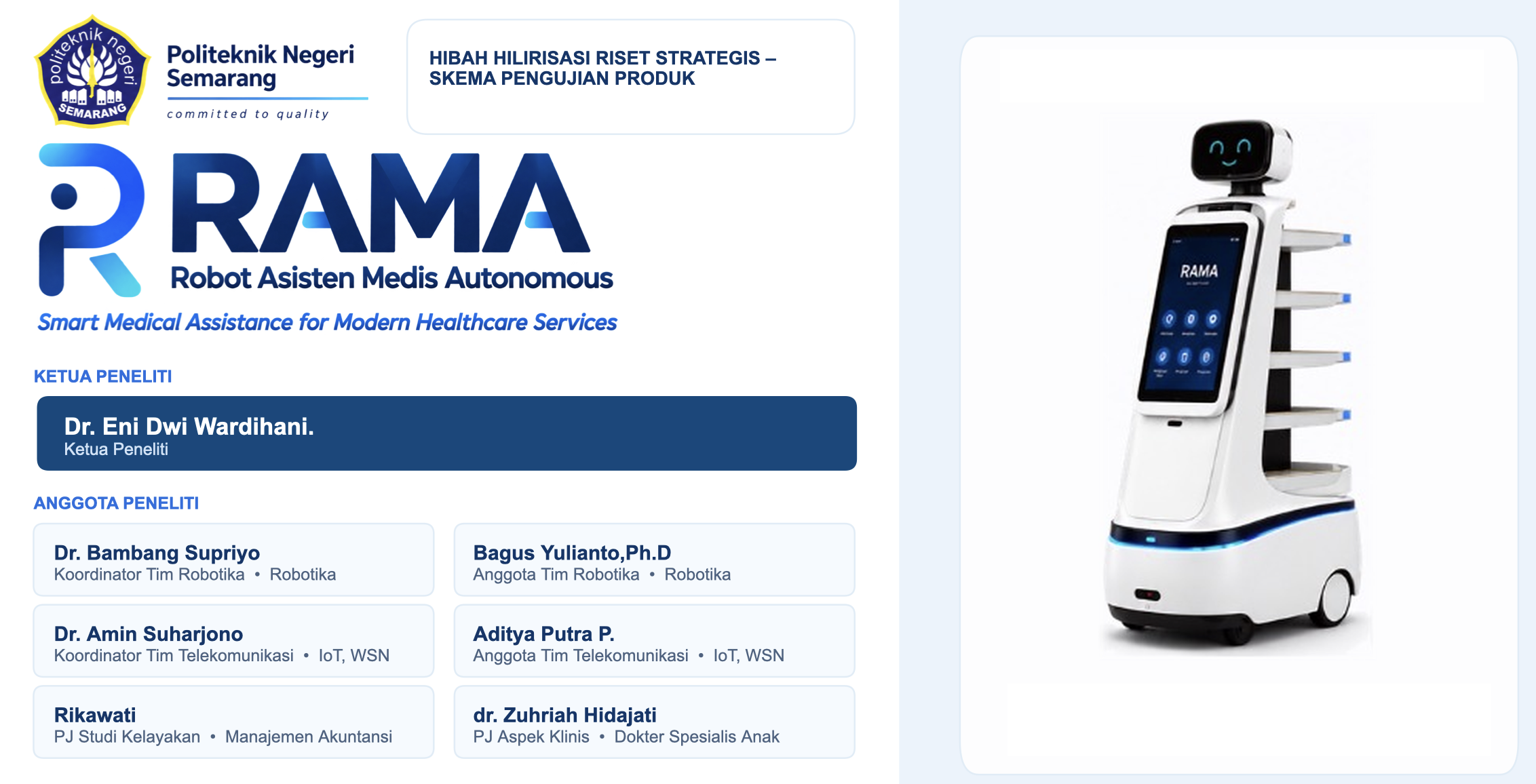
SEMARANG – Waiting in exhausting hospital queues or worrying about contracting illnesses while seeking medical treatment may soon become a thing of the past. On Friday, October 30, 2026, Semarang State Polytechnic (Polines) held a crucial Focus Group Discussion (FGD) to analyze needs and refine RAMA (Autonomous Medical Assistant Robot), an innovation poised to transform the landscape of healthcare services for the wider community.
Developed by a research team led by Dr. Eni Dwi Wardihani, this innovation is specifically designed to address the challenges of queuing and high workloads in primary healthcare facilities.
"RAMA 3.0 is no longer just a laboratory prototype. Through this FGD, we want to ensure that every feature developed genuinely addresses the pain points of healthcare workers in the field. We designed RAMA to be a robust supporting assistant, allowing nurses to be relieved of time-consuming technical routines and focus more on humanistic nursing care services," emphasized Dr. Eni Dwi Wardihani as the Head of the Research Team.
Through this FGD, Polines gathered input from various stakeholders, ranging from prospective users (including doctors and hospital management), regulators, to industry players such as PT Rohde & Schwarz and clinical development partners from Wongsonegoro Hospital.
For hospitals, this innovation is considered highly relevant to current patient care needs. "Our biggest challenge during peak hours is the accumulation of screening queues and the risk of infection exposure in the registration area. The presence of RAMA, which is capable of measuring body temperature, blood pressure, and oxygen saturation (SpO₂) without physical contact, is a brilliant solution. Our feedback in the FGD earlier focused on simplifying the user interface so that elderly patients can easily interact with this robot without confusion, including data synchronization with the Ministry of Health," stated the representative of RSJD Dr. Amino Gondohutomo.
Complementing these screening features, the Director of Diponegoro National Hospital also provided strategic input to optimize RAMA's functions at the forefront of clinical services. "So that RAMA can function as a comprehensive initial screening station, we suggest adding weight and height measurement instruments. This baseline data is essential for automatically calculating Body Mass Index (BMI) and patient medication dosages before they enter the doctor's examination room," suggested the Director of RSND during the discussion.
In addition to vital sign screening, thanks to artificial intelligence technology (Local LLM), patients who are confused in the hospital can naturally ask RAMA about room locations, polyclinic flows, or service guides. Physically, this robot is designed to be friendly and safe to maneuver in hospital corridors.
The robot is designed modularly to deliver medicine, medical documents, or food hygienically. Regarding production readiness, industry partners provided important notes to ensure this innovation is ready for market.
"From an industrial perspective, RAMA has tremendous commercialization potential. Our focus in this collaboration is to ensure the standardization of electrical components and the precision of its medical sensor calibration. Thus, when it enters the mass production stage, RAMA will fully comply with national medical device regulatory standards (AKD) and guarantee public safety," added the representative from PT Rohde & Schwarz.
Through this Strategic Research Downstreaming Grant program, the development team hopes that RAMA will soon pass limited trials in hospitals and achieve a higher Technology Readiness Level (TRL). With solid synergy among academics, industry, and health practitioners, RAMA is now not just research on paper, but a real leap toward safer, faster Indonesian medical services that prioritize public comfort.
Author: Aditya Putra
Editor: Juli Widiyanto