

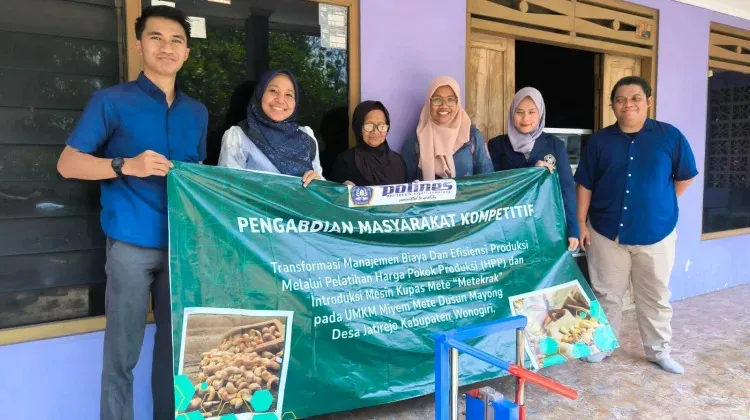
The micro, small, and medium enterprise (MSME) initiated by Miyem and now managed together with her son, Agus Prasetyo, produces fried cashews known for their savory taste and cleanliness, as they use branded packaged cooking oil. The products are marketed through loyal word-of-mouth customers, and they have even received orders from outside Java. However, production limitations have prevented the business from meeting all demands, especially ahead of religious holidays.
Previously, the hard cashew shells had to be peeled one by one using a knife. Shelling one kilogram of cashews took about an hour, while the minimum production requirement reached 10 kilograms per day. Aside from slowing down production, this method also posed a risk of injuring Miyem's hands.
The Polines team, chaired by Mirasanti Wahyuni, S.E., M.Si., and involving three Diploma 3 Accounting students, subsequently handed over the Metekrak machine. The machine uses a pressing lever. Raw cashew nuts are placed on a holder, and the lever is then pulled to split the hard shell in a single motion.
The use of this machine is targeted to cut down the shelling time to 5–10 minutes per kilogram. In addition to accelerating the work, the process makes it easier to extract the cashew kernels intact and reduces the risk of hand injuries, as they no longer come into direct contact with a knife. After receiving a demonstration and mentoring from the team, Miyem also directly tried operating the machine independently.
“Wow, the shelling results are great, none of them broke,” Miyem said through a written statement on Tuesday, November 10, 2026. In addition to helping increase production capacity, the Polines team also provided training on the calculation of Cost of Goods Sold (COGS). Previously, selling prices were still determined based on estimation, so shipping costs and other additional expenses were often unaccounted for.
During the training, the partner was guided to record and categorize all production costs, including raw materials, labor, and overhead costs. The COGS calculation per kilogram is then used as a basis to determine the selling price so that all production costs are covered and the business continues to make a profit.
The team also helped update the packaging of Miyem Mete products to make them more informative and attractive. The new label is equipped with a logo, the inscription “Original Wonogiri”, net weight options of 0.25 kilograms, 0.5 kilograms, and 1 kilogram, ingredients, a halal logo, a P-IRT number, a barcode, and an expiration date. This update is expected to increase consumer trust, especially among new buyers.
The team chair, Mirasanti Wahyuni, stated that all activity costs were sourced from the DIPA Fund of P3M Semarang State Polytechnic for Fiscal Year 2026. The mentoring will be continued through the implementation of COGS calculations using actual cost data and the monitoring of the use of the Metekrak machine.
Through this program, Polines hopes that the Miyem Mete MSME will be able to increase production capacity, fulfill more orders, and set appropriate selling prices. The improvements in the production process, cost recording, and product packaging are expected to strengthen competitiveness and expand the marketing of Wonogiri’s signature cashews.
Source : rri.co.id