

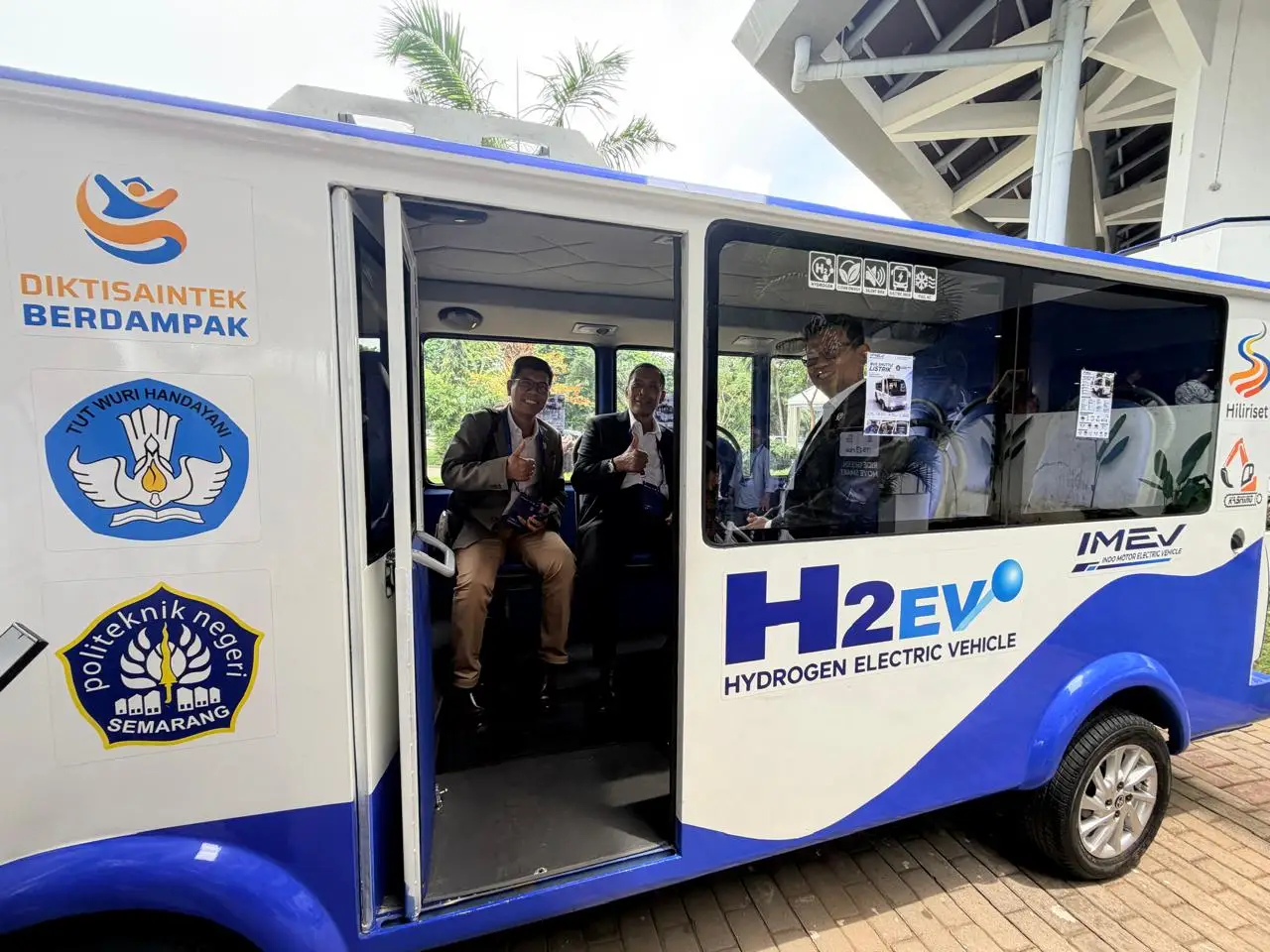
SEMARANG – A hydrogen electric shuttle bus developed by a Professor from the Department of Mechanical Engineering at Semarang State Polytechnic (Polines), Prof. Ir. Yusuf Dewantoro Herlambang, S.T., M.T., Ph.D., IPM., ASEAN Eng., took center stage at the 2026 Indonesian Science, Technology, and Industry Convention (KSTI) exhibition at Institut Teknologi Sepuluh Nopember (ITS), Surabaya.
During the event held on November 10–13, 2026, Polines not only showcased a prototype resulting from vocational research, but also engaged in business pitching with prospective investors and industry partners.
"This KSTI brings together academic research products and inventors with the industrial sector and investors. We hope to find industry partners interested in developing and producing this hydrogen bus," said Prof. Yusuf when met at the Polines Semarang Campus before departing for Surabaya on Tuesday (11/10/2026).
Moving forward, the bus is projected to serve limited-area mobility, ranging from airports, hospitals, campuses, and tourist destinations to industrial estates.
To propel its wheels, the bus combines two electrical systems. Its primary driver relies on a 15 kW Permanent Magnet Synchronous Motor (PMSM) (96 V DC traction system) supplied by a Lithium Iron Phosphate (LiFePO4) battery with a capacity of 250 Ah, or approximately 24 kWh.
Meanwhile, a 1 kW hydrogen Proton Exchange Membrane (PEM) Fuel Cell system (48 V line) is tasked with supporting the hydrogen auxiliary system. Through a 48 V to 12 V (600 W) DC-DC converter, hydrogen gas supplies power to secondary devices such as the ECU, lights, instrument panels, wipers, and the horn so that the primary battery load is not depleted. According to Prof. Yusuf, this scheme is only the initial stage of the development roadmap for his hydrogen vehicle.
"Currently, hydrogen merely backs up the auxiliary electrical system. If research funding continues next year, we will increase the fuel cell capacity to recharge the main battery as a range extender so that its traveling distance can reach a projected 400 kilometers, eventually serving as the primary propulsion replacing conventional batteries," he said.
The research on this bus is a long-term development by Prof. Yusuf, who has focused on fuel cell technology since his doctoral studies in Taiwan in 2017. Before taking the form of a bus, his team first designed a hydrogen-powered electric pickup truck prototype for transporting rural agricultural products through funding from BRIN in 2023–2024.
The project continues to progress thanks to the support of the Directorate of Downstreaming and Partnerships (DHK) of the Ministry of Higher Education, Science, and Technology (Kemdiktisaintek) under the Synergy scheme and BIMA funding. Together with students, the Polines team also independently produces green hydrogen through solar-powered water electrolysis (PLTS), while pioneering a Public Electric Vehicle Charging Station (SPKLU) and a Hydrogen Refueling Station (SPBH) on the campus grounds.
The strengthening of research and the hydrogen ecosystem at Polines is also promoted through international collaboration via the Impactful Diaspora program held on October 4–11, 2026. This activity featured a fuel cell expert from the Fuel Cell Institute at Universiti Kebangsaan Malaysia (UKM), Prof. Ir. Dr. Edy Herianto Majlan, IPM., AMIChemE., APEC Eng., ASEAN Eng., to conduct knowledge transfer and explore joint research in the fields of hydrogen energy and renewable energy for both lecturers and students.
At the national level, Polines is also preparing research collaboration with the Electrochemical Research Collaboration Center (PKR) consortium, chaired by Universitas Diponegoro (Undip) alongside BRIN, UI, Unair, Unpad, UPI, and Unnes. This consortium brings together academic experts across campuses to accelerate the application and development of PEM Fuel Cell technology to strengthen the hydrogen energy ecosystem in Indonesia.
Through various collaborations and this clean energy ecosystem, the Mechanical Engineering research at Polines also supports the targets of the Sustainable Development Goals (SDGs), particularly in the sectors of affordable and clean energy (SDG 7) and sustainable cities and communities (SDG 11).
Author: Muhammad Devan B
Editor: Juli Widiyanto