

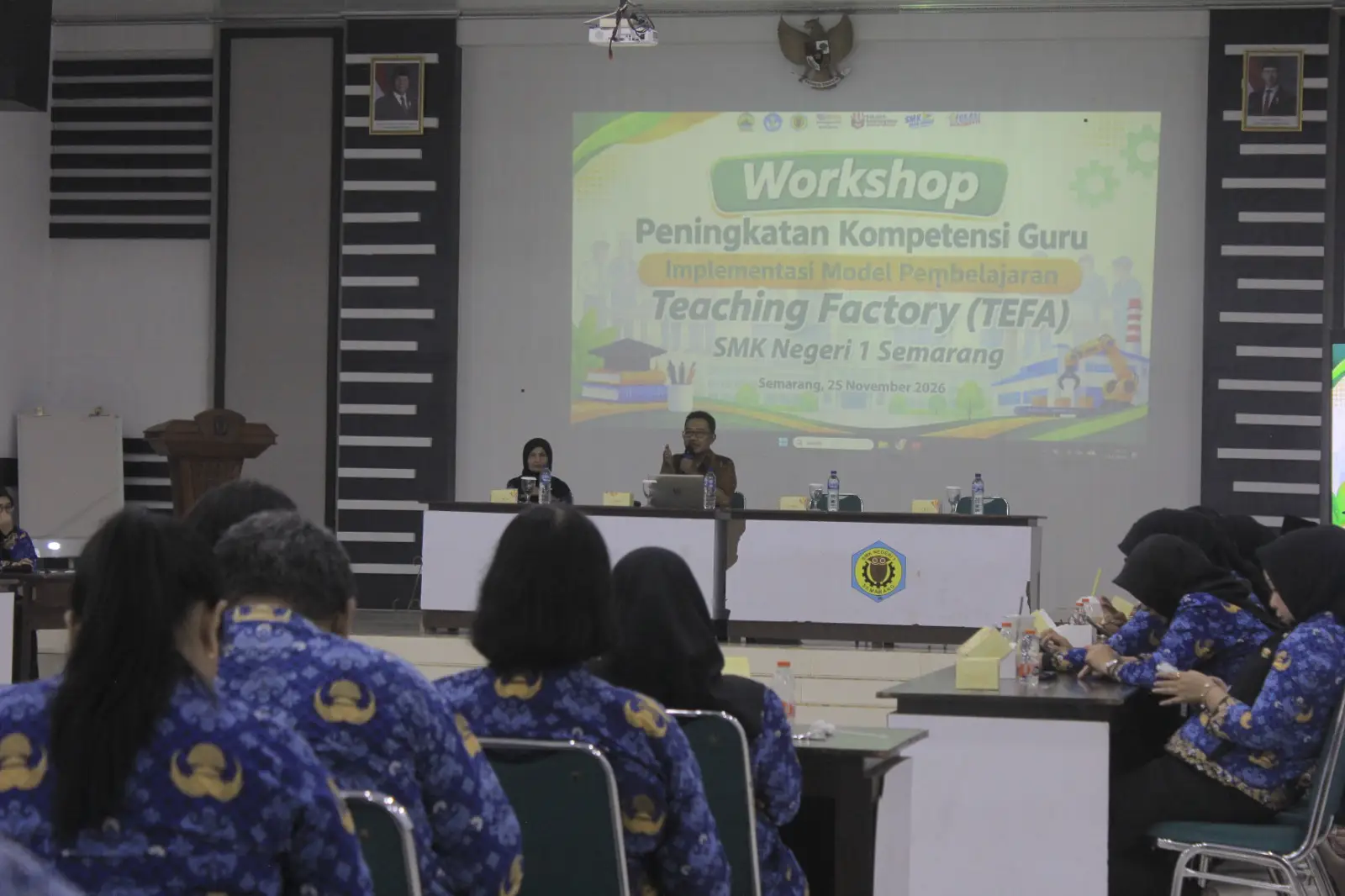
SEMARANG – Semarang State Polytechnic (Polines) has reaffirmed its role as a reference for vocational education by assisting in the implementation of the Teaching Factory (TEFA) ecosystem at SMK Negeri 1 Semarang. In an event entitled Teacher Competency Improvement Workshop on the Implementation of the Teaching Factory (TEFA) Learning Model on Wednesday (11/25/2026), Polines Leadership assigned Department of Electrical Engineering Lecturer, Thomas Agung Setyawan, S.T., M.T., as a resource person.
This assignment is a manifestation of Polines' commitment to sharing best practices in TEFA governance that have been established within the campus environment, particularly in the Department of Electrical Engineering. Armed with the 2026 TEFA Guidebook and Catalog, the Polines Department of Electrical Engineering has integrated the academic curriculum with professional industry work culture across various study programs including Electronics Engineering, Electrical Engineering, Informatics Engineering, and Telecommunications Engineering. This ecosystem houses a variety of superior services, ranging from manufacturing and fabrication, engineering and consulting services, to training and certification. This ecosystem can also be integrated with the one at SMK N 1 Semarang, as this vocational school also has various specializations including Electrical Power Engineering, Electronics Engineering, Mechanical Engineering, Automotive Engineering, and Broadcasting and Film Arts.
Taking place in the Hall of SMK Negeri 1 Semarang from 08:30 to 11:30 Western Indonesian Time (WIB), the event series began with the singing of the Indonesia Raya national anthem, followed by remarks and the opening ceremony by the Vice Principal for Curriculum of SMKN 1 Semarang, Muntamah, S.Pd, and continued with a presentation by Thomas Agung Setyawan on the Concepts and Implementation of the Teaching Factory (TEFA) Learning Model, followed by an interactive discussion.
In his presentation, Thomas explained that TEFA is a learning model that combines Competency Based Training and Production Based Training so that students become accustomed to producing goods and services in accordance with procedures and the standards of the working world.
"The main essence of Teaching Factory is to bring the atmosphere of the industrial work world—including the culture of discipline, standard operating procedures (SOPs), and time targets—into the classroom. However, it must be underlined that despite being production-based, the main focus of TEFA remains on mastering student competency, not merely pursuing commercial profits," said Thomas in front of the workshop participants.
Furthermore, he shared a practical framework that can be directly adapted by educators at the vocational high school (SMK) level. The material covers the seven main steps of the TEFA learning cycle, ranging from product identification, analysis, design, prototype development, mass production, quality control, to after-sales service. He also outlined three categories of TEFA implementation, namely based on student competency fulfillment, community needs, and industry world partnerships, along with five stages of application which include socialization, organization, partner strengthening, learning implementation, and evaluation and follow-up.
According to Thomas, sharing TEFA governance experience from vocational higher education institutions to vocational high schools is a crucial step to building sustainable alignment (link and match) with the business and industrial world (DUDI).
"In the Polines Department of Electrical Engineering, we continue to build a structured TEFA ecosystem so that students are accustomed to facing real challenges in the field. Through this collaboration with SMKN 1 Semarang, we hope that this governance model can become a tangible reference for teachers in honing hard skills, shaping soft skills and a professional work culture, while also fostering students' entrepreneurial spirit," he added.
Through this assistance, Polines not only contributes to improving the capacity of educators at SMKN 1 Semarang, but also strengthens its position as a strategic partner driving the quality of vocational education in producing work-ready and highly competitive graduates.
Author : Aditya Putra
Editor : Juli Widiyanto