

Plt. Director Polines Invited by RDP Education Financing Committee X DPR RI
polines
Author
2
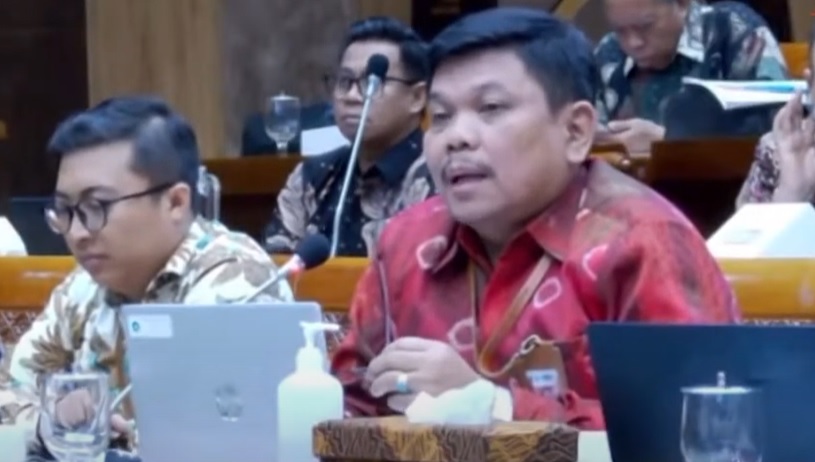
JAKARTA – Plt. Director of Semarang State Polytechnic (Polines) Dr. Karnowahadi, S,E., M.M. invited to a Hearing Meeting (RDP) with the Education Financing Working Committee (Panja) of Commission
JAKARTA – Plt. Director of Semarang State Polytechnic (Polines) Dr. Karnowahadi, S,E., M.M. invited to a Hearing Meeting (RDP) with the Education Financing Working Committee (Panja) of Commission
This Hearing Meeting was chaired by the Deputy Chair of Commission X or Chair of the Education Financing Working Committee, Dr. Dede Yusuf, M.E., M.I.Pol. which was also attended by the Chancellor of the University of Indonesia, the Chancellor of Hasanuddin University, the Chancellor of the University of Riau, the Chancellor of Nusa Cendana University Kupang, the Chancellor of the Indonesian Arts and Culture Institute (ISBI) Bandung and the Director of the Sriwijaya State Polytechnic in Palembang
Dr. Karnowahadi, S,E., M.M. as Plt. Director Polines highlighted the budget allocation from the Government which consists of Pure Rupiah (RM) and State University Operational Assistance (BOPTN). These budget sources include office operations, salaries, performance allowances, lecturer certification allowances and honorary allowances for professors.
"In the last five years, the operational budget for the office itself has decreased, on the one hand, operational costs are getting higher. Furthermore, for functional allowances for lecturers, there has been no change or increase for almost 17 (seventeen) years, so there is a significant difference with allowances for Educational Laboratory Staff and other Functional Positions," he said.
Furthermore, regarding the implementation of the 20 (twenty) percent allocation of the education function budget, he said there was a need to reformulate the budget allocation for equipment renewal.
"In this case, Polytechnics, especially Polytechnics, the existing equipment is a product from 1982 and has never been refurbished because the costs are very large, where one piece of equipment reaches 1 (one) to 2 (two) billion, especially study programs in the Mechanical Engineering and Electrical Engineering departments," he said.
Plt. Director Polines said that the principle of learning in Polytechnic Higher Education is "one student one tool" which has the consequence of higher costs.
"So at this Polytechnic, one student is one tool, so a special budget is needed for the laboratory and workshop equipment revitalization program which is equivalent to current industrial progress. On the other hand, we also hope that there will be no dichotomy between State Universities and Private Universities, both in terms of the amount of funding and the ability to educate the nation. The difference is in the source of funding," he explained.
Regarding more affordable education costs, he added that it is necessary to provide subsidies or assistance to underprivileged students either through scholarship schemes or inter-ministerial cooperation schemes.
"We told you a little that every year when re-registering, many students and their parents queue up at the campus finance department to ask for relief so they can pay the Single Tuition Fee (UKT) in installments because they can't afford it. It can be seen from our total number of students of 7,600 each semester that at least 500 students definitely apply," he added.
At the end of his presentation, he stated that the education budget allocation needed to be increased because it involved the ideal quality of education.
"In the allocation of the education budget and its implementation, we really hope that appropriate proportions will be given and even need to be increased and ensure that at least 20 percent of the APBN and APBD are allocated for education under the Ministry of Education and Culture," he concluded. (ang/jul)