

Collaborating with Polines, PK Muhammadiyah Vocational School Urges to Implement 'Pikohydro' Learning
polines
Author
2
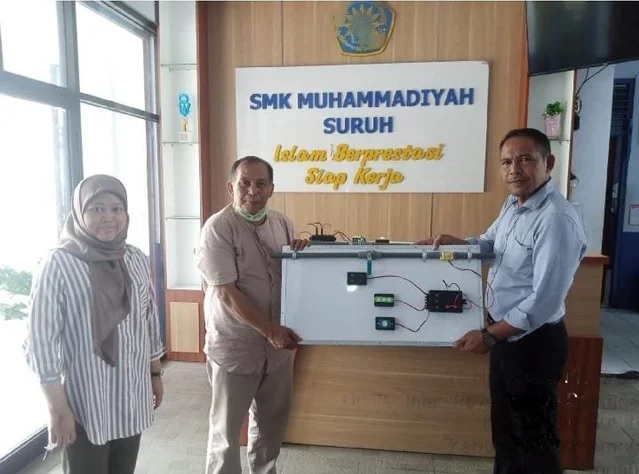
In collaboration with the Semarang State Polytechnic (Polines), SMK PK (Center of Excellence) Muhammadyah asked Semarang Regency to carry out real project-based learning (real projects) with the theme Energy...
In collaboration with Semarang State Polytechnic (Polines), SMK PK (Center of Excellence) Muhammadyah asked Semarang Regency to carry out real project-based learning (real projects) with the theme Renewable Energy Using Pikohydro, Tuesday (15/11/2022).
This theme was chosen because water resources in Salatiga are abundant but their utilization is not optimal. There are various ideas for utilizing natural water resource management, including renewable energy with picohydro, hydroponic/aquaponic design, and water treatment to make it more hygienic.
This time what was chosen was renewable energy with picohydro. To support this process, the school collaborates with one of the vocational higher education institutions in Semarang, Semarang State Polytechnic (Polines). Learning is carried out in the Electrical Power Installation Engineering Workshop Room (TITL) at SMK PK Muhammadyah Suruh.
The series of activities began with a Focus Group Discussion (FGD) to equalize perceptions about how to create learning modules for real picohydro projects. It was agreed that Polines, in this case, was represented by three lecturers, namely Drs Poedji Haryanto SST MT (Department of Mechanical Engineering), Iswanti SSi MSc and Suryono ST MEng (both Department of Electrical Engineering) to assist in the module creation process.
"Three modules are assembled by combining a mini pico-hydro electric generator using water flow power (pipe lines) with an output voltage of 12V DC (there is a regulator in it) vertical and horizontal types and several DC light loads with a voltage of 12 V DC which are manually controlled with a switch. This circuit is then equipped with pipes and taps to regulate the water input and output," said Poedji Haryanto.
According to him, the module is made with a 3cm thick board equipped with Formica to make the board more water resistant and L-list made of aluminum. At the end of the learning, the learning module was handed over between Polines, represented by Poedji Haryanto and Iswanti, and the Principal of SMK PK Muhammdyah Suruh Wahyudi Jaya ST.
Furthermore, said Poedji, this real project-based learning was carried out with three modules in class XII in the TITL Department. Because this learning is practical, students are required to wear practical uniforms. They carry out practices starting with ensuring that there is a flow of water with a strong enough discharge with a water hose at the water intake section and arranging the water disposal section so that the water does not spill over and be wasted.
After that, the practice continued to observe the electric current generated by the picohydro generator by turning on the light load installed in the learning module. There are three lights installed so that it allows students to observe that if the electric power produced is strong enough then all the lights can light up simultaneously with maximum incandescence. However, if it turns out that the water flow is not very strong, it will appear that some of the lights cannot turn on properly.
Furthermore, students also measure how much voltage is produced by the generator without load and with load. Practical activities were fun, marked by all students making observations and measurements.
"It is hoped that this lesson will be able to stimulate students to carry out various creativity in relation to the potential they live in for activities that are beneficial to themselves, the school or the surrounding community.
"Furthermore, this collaboration will continue to produce a Patent in the form of Copyright for the work of the learning module and then there will be mentoring activities for continuous improvement with the module," said Poedji.
Poedji hopes that the use of the module will be maximized. Apart from that, this module is planned to appear to enliven the Muhammadyah Mukmatar activities on November 19 in Surakarta. (Sgi)
Source https://www.krjogja.com